A historical spread field can be reproduced perfectly from its original source and still fail to transfer to a different provider. This note separates provenance, same-source parity and provider portability.
Recovering provenance
A local EURUSD M15 research file retained macOS origin metadata pointing to data.forexsb.com. Its raw structure contained OHLC, volume and a seventh field used throughout the research as spread data.
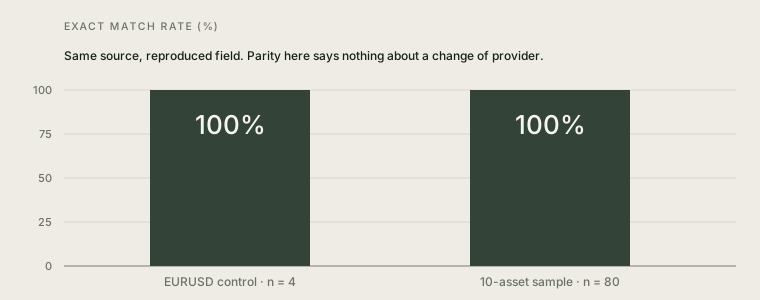
The source was independently redownloaded and compared against local historical observations. The tested EURUSD spread values matched, and the check was later extended across ten FX assets, where the selected last-bar comparisons also matched exactly.
The initial EURUSD control reproduced all four tested spread observations exactly. The check was then extended to the latest eight observations on each of ten FX assets. All 80 compared values matched the recovered ForexSB source exactly in that sample.
What same-source parity proves
Same-source parity is a lineage result: it says the historical field used by the model is reproducible from the identified source over the tested observations. It does not say that another provider encodes the same economic object in the same way.
Testing a provider change
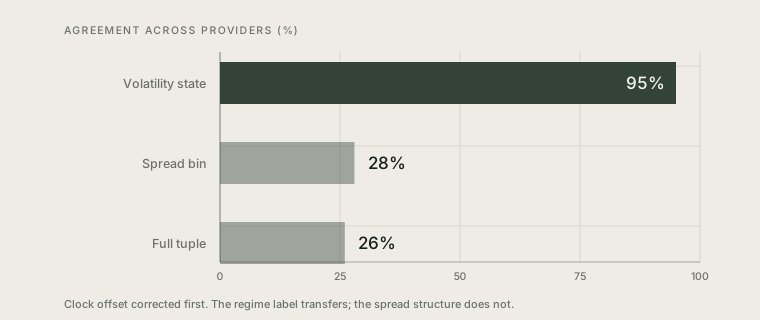
A separate provider-transfer audit aligned historical research data with an XM environment. Price alignment became extremely strong after a common clock correction. The spread-derived structure did not exhibit the same transfer quality.
After the common clock correction, volatility-state structure remained highly consistent at roughly 95%, while spread-bin agreement was only about 28%. The combined state tuple agreed on roughly 26% of observations. This gap is the central empirical reason the transfer was not promoted.
The audit therefore separated three conclusions:
CLOCK ALIGNMENT = PASSFEATURE TRANSFER = FAILTARGET SCALE ADAPTER = FAIL
The final provider verdict was CLOCK_ALIGNMENT_PASS__FEATURE_TRANSFER_NOT_PROVEN.
Research implication
A microstructure-dependent model should not be ported by applying a cosmetic scale conversion. Provider-specific spread behavior may need its own target definition, calibration and prospective collection regime.
Limitations
- Same-source parity was verified on selected windows, not every historical row ever used in research.
- The provider comparison concerns the available sources and does not establish a universal hierarchy of data providers.
- The exact vendor-side semantics of historical spread fields should be documented independently before commercial redistribution or licensing.